


Manifest
#takecareresidenz Fonds Daku / Künstlerhaus Mousonturm
März – Mai 2021
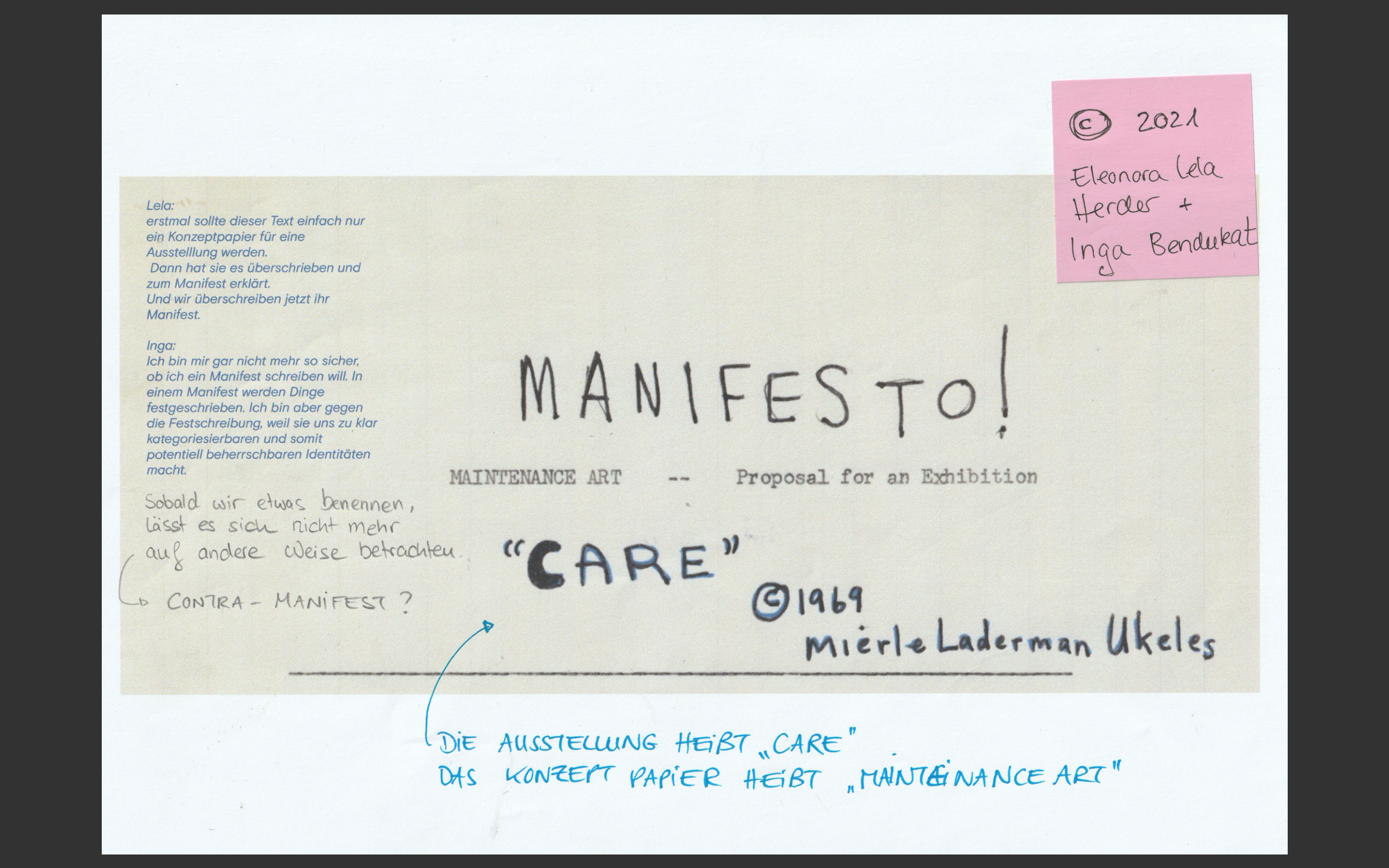
Die bildende Künstlerin Mierle Ladermann Ukuele fragte bereits im Jahr 1969 in ihrem ‚Manifesto of Maintenance Art‘ was Kunst bedeutet, wenn sie sich als Sorgearbeit versteht. Ein zentraler Satz Ukeles, der uns dabei immer wieder umtrieben hat, war ihre Frage: „After the revolution, who’s going to pick up the garbage on Monday morning?“ Wer trägt die Sorgearbeit für die Revolution, für die Versammlung? Wer ist da, aber niemals sichtbar? Und inwiefern können diese Körper, die nicht verhandelt werden, Teil unserer künstlerischen Praxis werden? Was ist das für eine Versammlung, wenn diejenigen zusammenkommen, die sind, die im Theater erstmal nicht vorgesehen sind? Und wer sagt, dass diejenigen überhaupt im Theater erscheinen wollen? Wie müssen Institutionen strukturiert sein, damit diejenigen, die die Sorgearbeit für die Kunst tragen, auch Teil der Kunst sind? Wo und in welchen Formen kann in alltäglichen, in einer Routine performten Sorge- und Instandhaltungsarbeit ein künstlerisches Moment liegen?
Anhand dieser Fragestellungen arbeiten wir zurzeit an einer Aktualisierung des Manifestes von Ukeles aus gegenwärtiger feministischer und queerfeministischer Perspektive. Wir möchten uns mit anderen Künstler*innen, die sich auf der Schnittstelle zwischen Kunst und Community-Arbeit bewegen, vernetzen und mittels Interviews versuchen zu erörtern, welche räumlichen und zeitlichen Begebenheiten erforderlich sind, um Maintenance Art auf einer institutionelle Ebene zu ermöglichen. Wir möchten fragen, wie wir das System der Institutionen unterlaufen müssen, um die zu tragende Sorgearbeit als Teil der künstlerischen Praxis zu verstehen.
In Kooperation mit dem Künstlerhaus Mousonturm. Ermöglicht durch die #takecareresidenz des Fonds Darstellende Künste
Eleonora Lela Herder is working as a freelance director, curator and dramaturg in Frankfurt Main, Barcelona and Warsaw. Her work oscillates between performance and spatial installation. In her current work she deals with urbanist and city political topics.
She is the founder and artistic director of the interdisciplinary label andpartnersincrime and a member of the artist association ID_Frankfurt, where she also co-curated the site-specific performance festival IMPLANTIEREN in 2018 and 2020.
She received a scholarship at Theatertreffen Berlin in 2015 and at Bienal del arte Buenos Aires in 2017.
I’m an artist, I’m a manager, I’m an employer, I’m a woman, I’m a wife, I’m a lover, I’m a friend, I’m going to be a mother, I’m a daughter, I’m a sister, I’m a granddaughter, I’m a scholar, I’m a teacher at university, I’m the cool aunt, I was an emerging artist, I’m an activist, I’m a target [kind of random order]
Inga Bendukat is a theater scholar, freelance dramaturg, and in her free time, an activist. She is currently working on her PHD: „Jenseits der repräsentativen Öffentlichkeit. Erscheinungsräume des Anderen (working title).“ In it, through the perspective of queer theory she examines the disruption of idelologies and searches for a theater of Entunterwerfung (Foucault), resistance and solidary practice. Since March 2021 she receives a scholarship from Ad Infinitum at the Goethe University.
Am I an artist? I am a theorist [but not terrorist]. I am an activist. [I wish] Radical queer [all your friends are criminals]? I am a dreamer, planing the revolution from my desk. [no order]
Lela und Inga haben sich während der gemeinsamen Arbeit an und in der ada_kantine näher kennengelernt. Während Inga das Projekt auf einer theoretischen Ebene begleitet hat, hat Lela gemeinsam mit ihrer Gruppe andpartnersincrime immer wieder versucht mit performativen Setzungen die Grenzen zwischen Kunst und Reproduktionsarbeit auszuloten. Daraus entstanden ist ein mehrteiliges Projekt zu Themen der Versammlung und Kunst als Vergemeinschaftung, das im vergangenen Jahr am Künstlerhaus Mousonturm und dem Historischen Museum Frankfurt gezeigt wurde.
Gefördert vom Kulturamt der Stadt Frankfurt und dem #takecare Stipendium des Fonds Darstellende Künste.
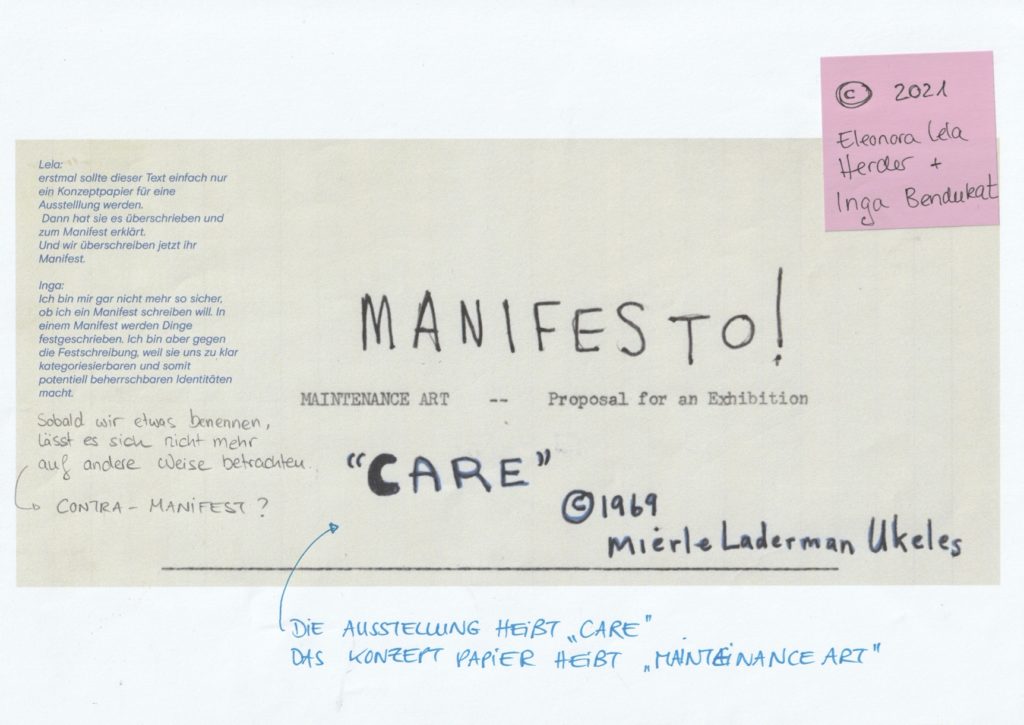
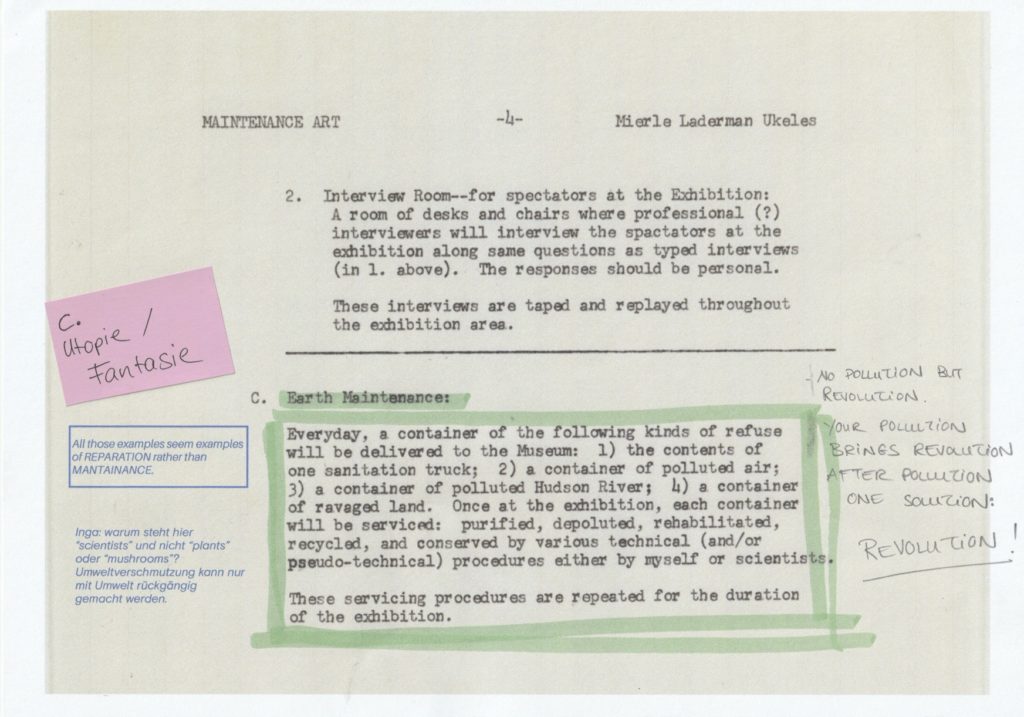
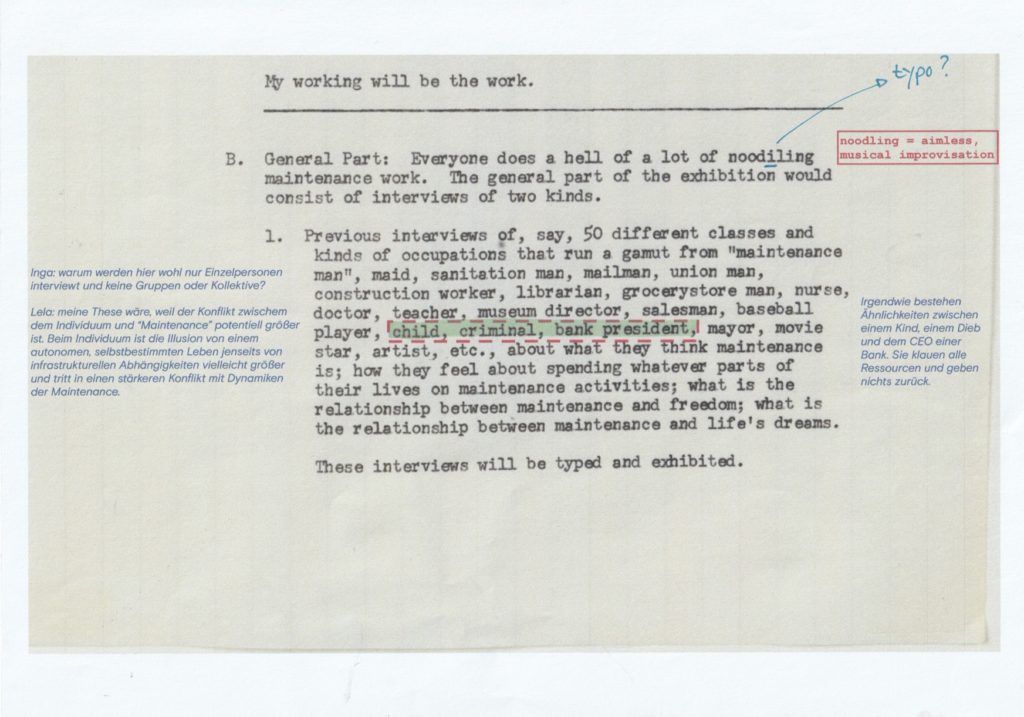
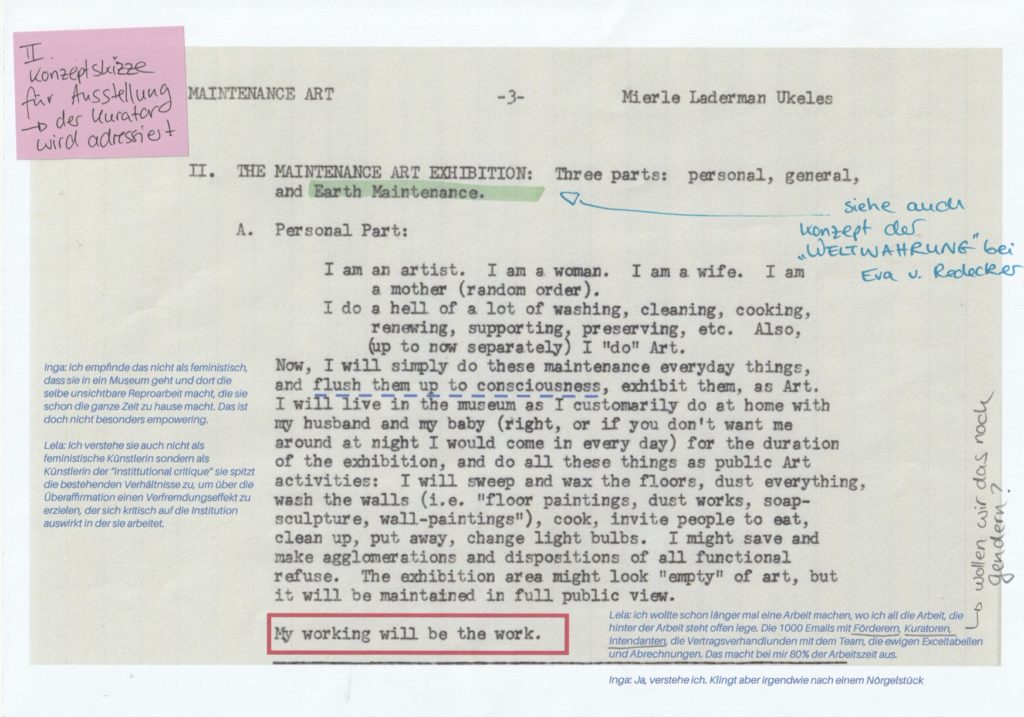
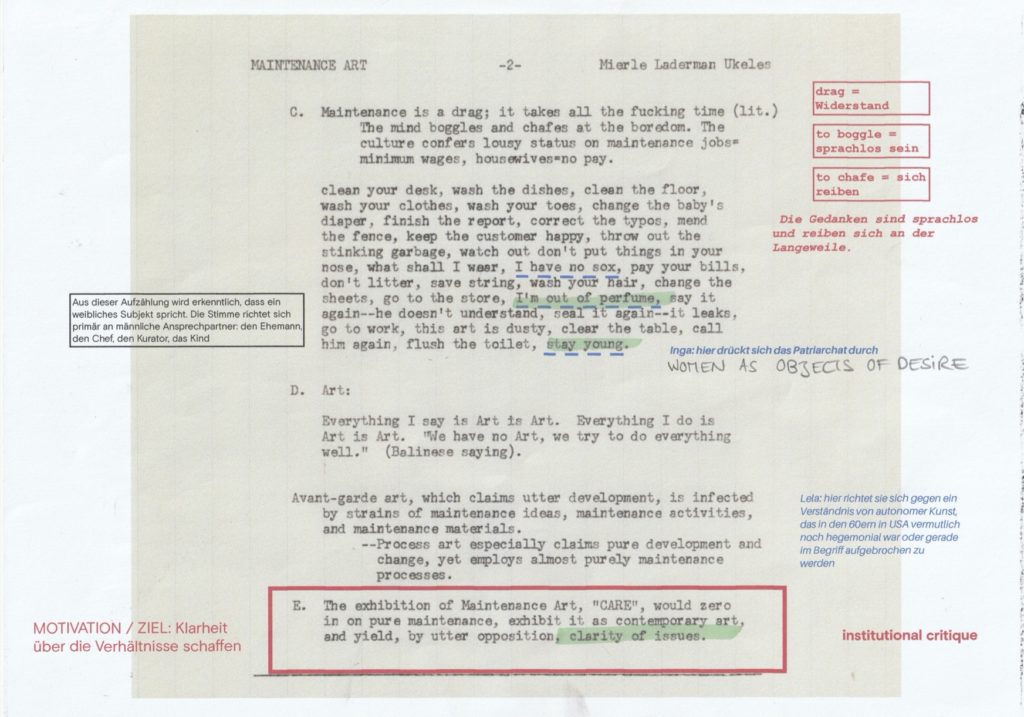
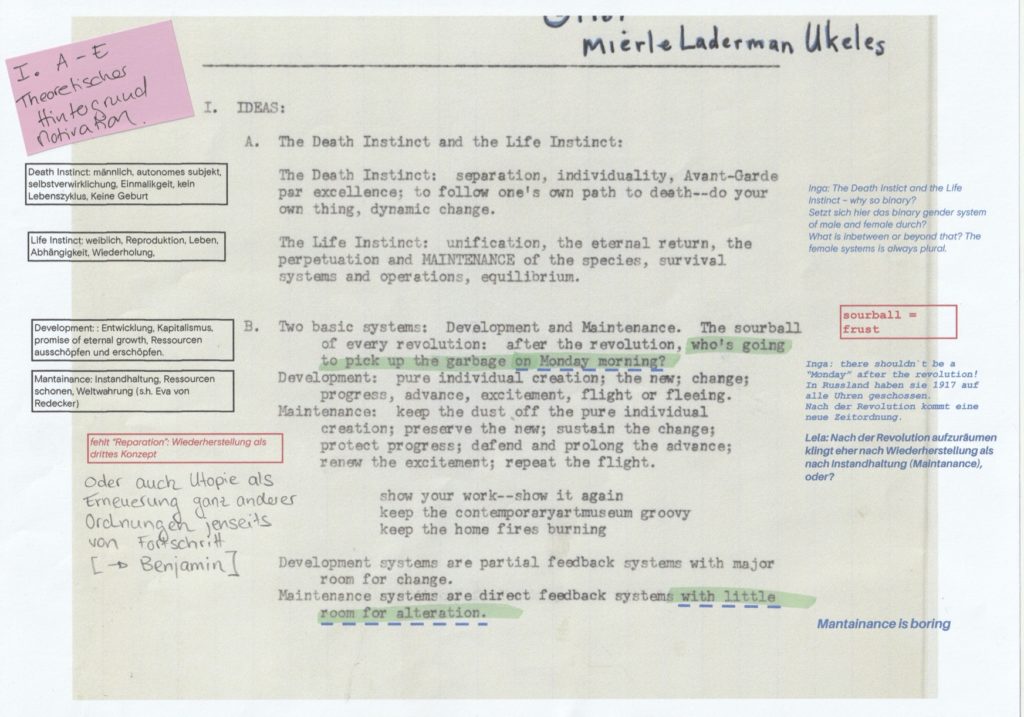
Für Ukeles stehen das Künstlerin- und Mutterdasein für zwei sich ausschließende Dynamiken des In-der-Welt-seins.
Avantgarde Künstler*innen sind autonom, progressiv und voranschreitend, sie definieren sich über ihre Einmaligkeit und müssen scheinbar unabhängig von materiellen Begebenheit agieren können.
Mutterschaft hingegen steht bei ihr für ein zyklisches System der Instandhaltung, für Abhängigkeit und Einschränkungen, für Routine, für Langeweile, für ein Agieren in einem Netz von Interdependenzen.
Kunst (so wie von der westlichen Moderne definiert) und Sorgearbeit sind sich also von ihrem Grundwesen her konträr und nicht vereinbar.
Seit einigen Jahren erfahren aber gerade Kunstformate, welche versuchen, diese Gegensätzlichkeit aufzuheben einen gesellschaftlichen Aufschwung. Immer mehr Künstler*innen versuchen aus der Dynamiken der ewig temporären, selbstreferentiellen Projektarbeit auszusteigen und ihre politischen und gesellschaftliche Anliegen in das Zentrum ihrer Arbeit zu stellen, immer mehr Kunstinstitutionen kommen nicht zuletzt aufgrund von schwindenden Besucher*innenzahlen in einen Legitimationsdruck und versuchen mit partizipativen, soziokulturellen Formaten ihr eigenes Schneekugeldasein zu verlassen.
Allen ist bewusst, dass wir als Gesellschaft dringend einen instandhaltenden Umgang mit den räumlichen und menschlichen Ressourcen, die uns zur Verfügung stehen, erproben müssen.
Leider gehen diese sozialen Experimente von Kunstinstitutionen nicht selten mit einer symbolischen Ausbeutung von prekarisierten und marginalisierten gesellschaftlichen Gruppen oder ihrer expliziten Exponierung einher. In den wenigsten Fällen wird hier so gearbeitet, dass es sich als nachhaltig und gesellschaftliche Zustände verändernd erweist. Zu oft wird die im Kunstmarkt übliche neoliberale Erschöpfung von menschlichen Ressourcen damit einfach auf weitere Kreise der Stadtgesellschaft ausgeweitet. Eine Instandhaltung findet nicht statt. Eine Neuformulierung ebenso wenig.